
Mastering the art of organizing cash receipts for better record keeping transforms a chaotic pile of paper into a clear, actionable financial history. Whether you are managing personal finances or running a small business, having a systematic approach prevents missed tax deductions and ensures you have proof of payment when it matters most.
By adopting a consistent routine for capturing and storing your documents, you eliminate the stress of tax season and gain a transparent view of your monthly cash flow. This article outlines practical methods to streamline your paperwork, helping you maintain accurate records with minimal effort while protecting your financial interests.
Establishing a Consistent Receipt Collection Routine
The foundation of effective record keeping starts the moment a transaction occurs. If you wait until the end of the month to sort your pockets or wallet, you are bound to lose vital documentation. Instead, create a dedicated space for your receipts as soon as you finish a purchase.
For many, this means carrying a slim, durable envelope in a briefcase or purse specifically for paper slips. When you arrive home or reach your office, transfer these items immediately to a permanent storage location.
Consistency beats intensity every single time. You do not need to spend hours each week; you only need to spend five minutes every few days. By making this a habit, you prevent the accumulation of faded, unreadable thermal paper.
Remember that many modern receipts fade within weeks, so timely processing is essential for your long-term records. If a receipt is critical for a business expense, take a photo of it immediately using a smartphone app to ensure you have a digital backup before the ink disappears.
Choosing Between Physical and Digital Storage
Deciding how to store your documents depends on your personal workflow and the volume of your transactions. Physical storage remains a reliable choice for those who prefer tactile organization, while digital systems offer unparalleled searchability.
Many professionals now utilize a hybrid approach to get the best of both worlds. You might keep original paper copies in a chronological filing system while maintaining a searchable cloud-based backup.
Digital storage offers a significant advantage regarding disaster recovery and space management. Using a scanner or a dedicated mobile application allows you to categorize your expenses by date, vendor, or project automatically.
This electronic trail is widely accepted by tax authorities as valid proof of payment, provided the images are clear and legible. However, if you choose a digital-only path, ensure your files are backed up to at least two separate locations, such as an external hard drive and a secure cloud service.
Understanding IRS Record Keeping Standards
The IRS does not mandate a specific format for your records, but it does require that they be accurate and complete. According to official guidelines regarding business record keeping, you must be able to prove the amount, the date, the place, and the business purpose of each expense.
While the famous “$75 rule” often causes confusion, it simply means that for expenses under $75, you are not strictly required to provide a receipt if you have other evidence. However, keeping the receipt remains the safest way to defend your deductions during an audit.
For cash payments, the burden of proof is higher because there is no bank statement to corroborate the transaction. Always prioritize keeping receipts for every cash-based business expense, regardless of the dollar amount.
If you are paying for services in cash, ask for a signed invoice or a handwritten receipt that clearly states the provider’s name and the nature of the work. These supporting documents serve as your primary defense if a tax examiner questions your claim.
Setting Up an Efficient Filing System
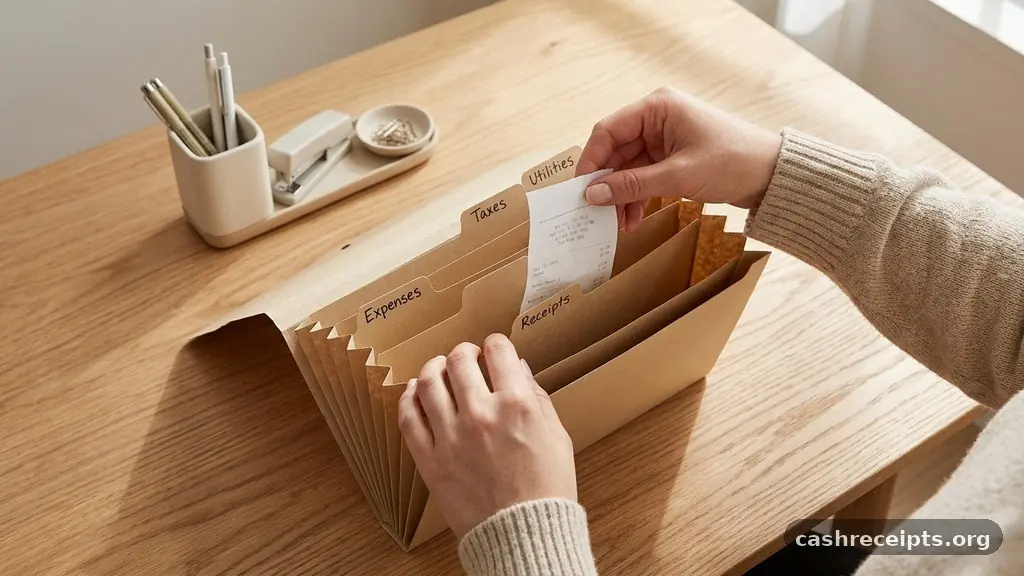
A functional filing system should be intuitive enough that you can retrieve any document within sixty seconds. For paper receipts, a simple accordion folder labeled by month or category works exceptionally well.
If you have high volumes of paperwork, consider using a filing cabinet with hanging folders color-coded by expense type. Keep your personal and business receipts strictly separated to prevent accidental commingling of funds.
If you opt for a digital-first approach, create a folder structure that mimics a physical system but adds the power of metadata. Use a naming convention that includes the date, the vendor, and the amount, such as “2023-10-15_OfficeDepot_45.00.”
This makes searching through your folders a breeze when you need to find a specific transaction months later. You can also utilize software that reads the data from the images, significantly reducing manual data entry time.
Managing Expenses with a Comparison Table
To visualize how different storage methods compare, consider the following breakdown. Each method serves a different purpose based on your specific needs and the nature of your business.
| Method | Best For | Pros | Cons |
|---|---|---|---|
| Physical Binder | High-volume paper users | Simple, no technology required | Space-intensive, hard to search |
| Cloud Storage | Remote workers/travelers | Accessible anywhere, searchable | Requires scanning, security risk |
| Accounting App | Small business owners | Automated data entry, tax-ready | Subscription cost, learning curve |
Common Pitfalls to Avoid in Record Keeping
One of the most frequent mistakes people make is failing to annotate their receipts. A receipt showing a $50 charge at a restaurant is useless if you don’t remember who you were with or what business was discussed.
Always write a quick note on the back of the slip or in your digital entry describing the purpose of the expense. This simple act transforms a generic document into a defensible business record.
Another common error is relying solely on credit card statements. While a credit card statement proves you spent money at a store, it does not detail what you bought.
If you are audited, the IRS needs to see itemized receipts to confirm the items were legitimate business expenses. Never assume that a bank statement alone will satisfy an auditor who is looking for evidence that a purchase was necessary and ordinary.
Frequently Asked Questions
What is the best way to keep receipts organized?
The best method is the one you will actually use consistently. Whether it is a digital app, a simple accordion folder, or a spreadsheet-based tracker, the key is to process your receipts at least once a week to prevent backlogs.
How long should I keep my receipts for tax purposes?
The general rule of thumb is to keep your records for at least three years from the date you filed your tax return. However, if you have complex business situations or are claiming certain credits, some financial experts recommend keeping them for up to seven years.
Can I use digital photos of my receipts?
Yes, the IRS accepts digital copies of receipts as long as they are legible and contain all the necessary information. Ensure your digital files are backed up, as losing the only copy of a digital record is equivalent to losing the original paper slip.
How do I handle receipts that fade over time?
Thermal paper receipts are notorious for fading, so you should scan or photograph them immediately. If the information is already fading, make a photocopy of it now, as the process of photocopying often helps preserve the ink for a longer period.
Is it necessary to keep grocery receipts for taxes?
You only need to keep grocery receipts if the items were purchased for a legitimate business purpose, such as office supplies or snacks for a staff meeting. If the groceries were for personal use, they are not tax-deductible and do not need to be saved.
Final Thoughts on Financial Organization
Maintaining control over your financial documentation is an investment in your peace of mind. By organizing cash receipts for better record keeping, you empower yourself to make informed decisions and ensure that every legitimate deduction is accounted for. Start by creating a habit that feels manageable for your current lifestyle, whether that involves a simple folder or a sophisticated digital app.
Over time, these small actions accumulate into a powerful, clear, and audit-ready history of your financial life. If you find your current system lacking, take the first step today by clearing out your wallet and setting up a dedicated space for your receipts. Your future self will thank you when tax season arrives with none of the usual stress or confusion.